- cross-posted to:
- [email protected]

- cross-posted to:
- [email protected]
You must log in or # to comment.
I noticed that the gun hasn’t gone off by the end of the page…this does not bode well
I’m concerned that I read this article first thing in the morning…
Once you’re aware of the concept of Chekhov’s gun, you start to instinctively spot devices that are meant to be called back later in the script and subconsciously anticipate them, making it a Pavlov-Chekhov gun.
But if the initial introduction of the Pavlov-Chekhov gun is too forced/obvious, you might feel compelled to turn off such a predictable movie before the device is recalled and you’ll never know if it was actually brought back. Maybe it was, maybe it wasn’t, maybe it exists in an unobserved quantum state… a Schrödinger-Pavlov-Chekhov gun.
My son and I love to spot Chekhov’s Guns. My favorite is the flame-thrower in Once Upon a Time in Hollywood. When he pulled it out at the end, my son and I both looked at each other and laughed. We didn’t see that coming.
Is there an opposite to this, where a detail is revealed later that makes you rethink the stuff from before?
I say it’s an opposite because you notice the gun and infer the ending, and what I mean is a reveal makes you notice the beginning.
I’m very tired, so I hope this makes sense.
Those are the best ones, where it sneaks by you early, and you don’t even think about it until it gets pulled out at the end.
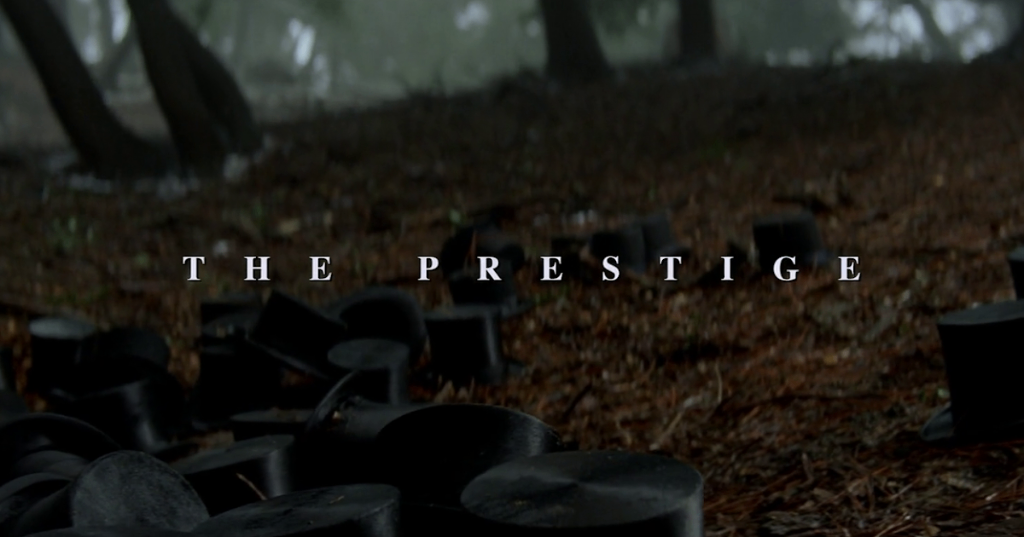
The Prestige
Spoiler
The reveal makes you think of the title card.
Spoiler
:::
The Prestige remains the best Nolan movie, in my opinion. It’s so good.
A few games do that from what I remember. Spec Ops: The Line is the first that comes to my mind.
spoiler
At the end of the game there is a cutscene that basically tells you that most things your player character was seeing were delusions, and going back to those points in the game you can actually see how your crew members notice something is wrong with you
It’s a tough road to walk. Maybe the main difference between real life and stories is that with real life, things just exist for no reason, things happen for thematically incoherent reasons all the time, there’s just too much stuff happening all the time to weave it all into a single coherent narrative. With stories, every element of the story exists because the author decided to add it. The reason may not be essential to the central theme of of the story, but everything exists for some narrative-centric reason. Once you notice that economy of reality, you start thinking about why any particular element of a story was put in, and most of the time there’s a… if not good reason, then at least some reason for every tiny detail of a story. Some authors are careless with their details, but for the most part authors are very particular about what details they use.
Chekov’s Gun is another way of saying that, at least for stories, everything really does happen for a reason. Sometimes people over-generalize this principle from stories to life.
I wanna see more people randomly coughing or sneezing in movies/shows.
100% of the time, a cough or sneeze is Chekov’s Sick. It’s boring. I want some character to pause in the middle of a rant, cough, go back into their rant, and attention never to be brought to it.

The most obnoxious Chekov’s Gun I’ve seen recently was in Good Fortune. It was a literal gun and it was so obvious what they were doing with it
What if I only want the audience to worry about the baddie having a loaded gun?
What if a policeman or a solider arrives on scene where there’s a violent opponent? To maintain verisimilitude, they should have a loaded gun.
I don’t think this principle should always apply.
It’s a broad generalisation, and you also have to remember Chekhov was a playwright. It makes a lot more sense if you think about the framework of a stage play. If there is a gun prop on the set, Chekhov’s Gun states that it should be used in the play in some manner.
In general, it is a different way of stating the adage “Perfection is achieved, not when there is nothing more to add, but when there is nothing left to take away.” ^(Antoine de Saint-Exupéry)^ It’s a narrative principle of succinctness: every element of the narrative should be essential to the whole.
Also, the whole thing came from letters Chekhov wrote giving advice to young playwrights. It was never meant to be an unbreakable rule governing all of narrative fiction.
That is indeed sometimes the case. Sometimes an object has another purpose. But when I’m watching a cheesy crime movie, if the cinematographer makes a point of showing a close up shot of a weapon, it’s a safe bet that the object is somehow going to figure in the plot. I notice with higher quality mysteries like Knives Out there are a lot of red herrings, not in the typical sense of intentionally misleading us, but trying to show how any crime solving process has dead ends on the pathway to the answer.
For example, if a gun is included in a story, there must be a reason for it, such as being fired at some later point.