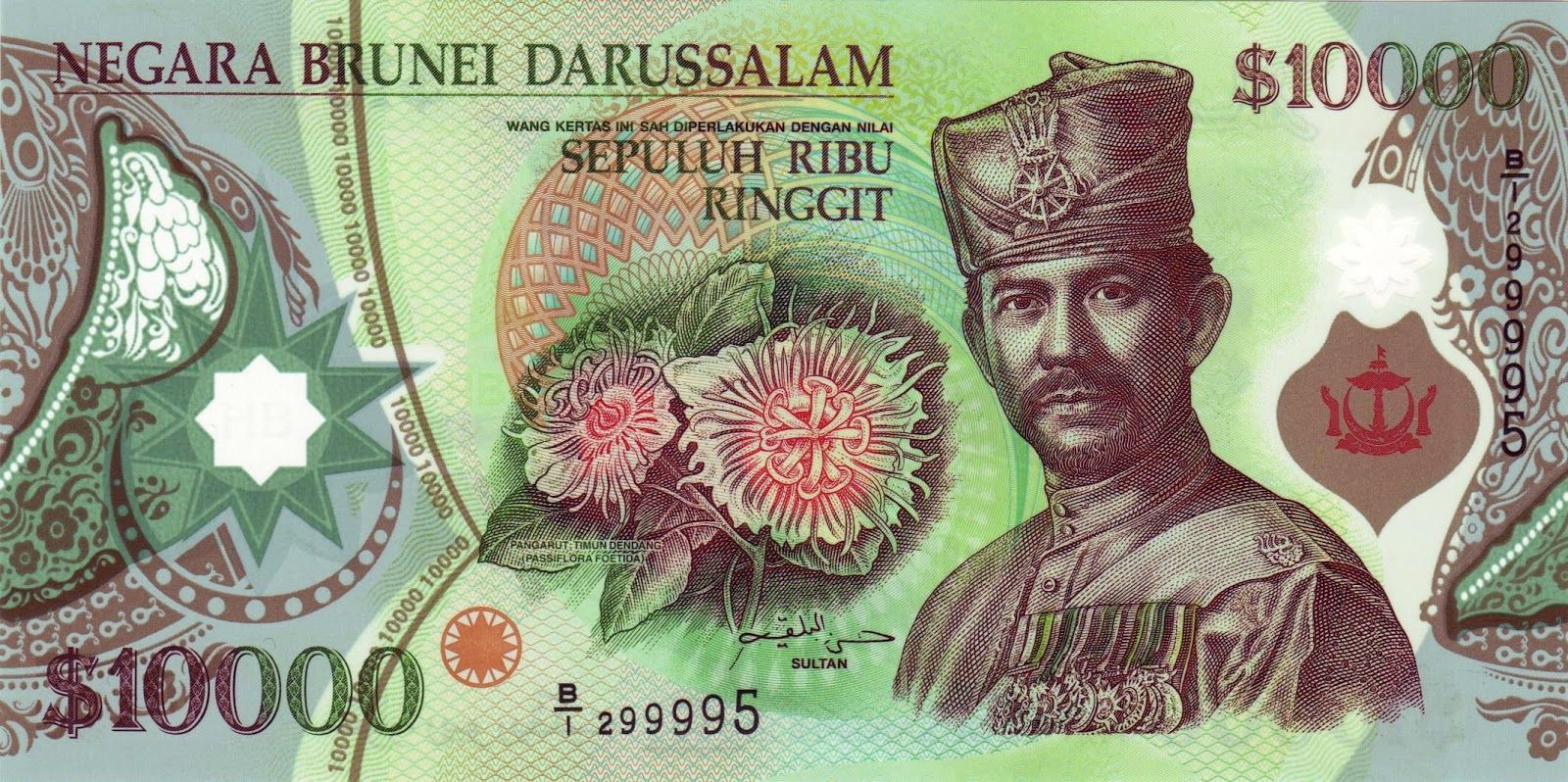
I mean, the 100 USD bill is NOT the highest valued bill in the world, that belongs to the former B$10000 bill (withdrawn) from Brunei (I’m serious, this exists) which is worth $7874 and yes it’s a single bill, also converting to around £5803 & 6677€ respectively. Like why does this bill even exist when it’s hard to encounter, given that Brunei is a petro-state, it comes as no surprise.
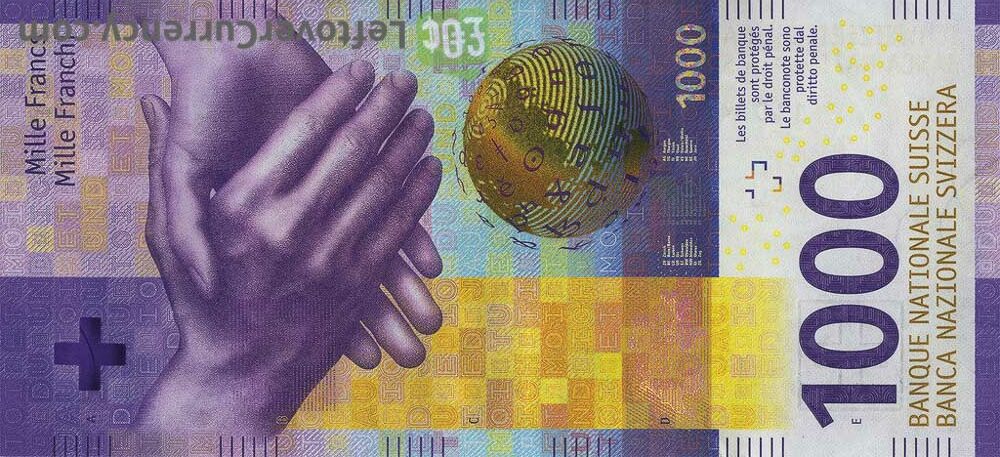
The second highest valued bill is Fr. 1000 ($1278) or £942 & 1084€ which isn’t a surprise for Switzerland to have that due to how expensive it is over there. But, it’s difficult to obtain even in Switzerland and has advanced security features making hard to counterfeit due to its high value (x12 times of $100) but they sell stuff that’s over Fr. 1000 anyway so it makes sense for them to have that.
The reason why they are barely featured in crime movies or mentioned in real crimes relating to counterfeit money is because of their obscurity and the fact that they don’t know both exist (but it does, although either really hard to get your hands on it or ceases to circulate) however still retains their face value. The Swiss Franc is deemed a “safe haven” currency while the US Dollar isn’t.
You must log in or # to comment.
It isn’t definitely the most counterfeited, it’s the most identified and most profitable. Hand over a $100 note and the pen comes out. Hand over a $10 and it doesn’t. If you’re bleaching a $1.00 note the $100 is the most profitable, but the $10 not is the least likely to be identified. $20 is a happy medium and if I had to guess the most likely to be professionally counterfeited.
It’s an interesting question because the statistics are only based on identified counterfeits.
It’s small enough you can use it for innocuous purchases, but unfamiliar enough that most people wouldn’t recognize any defects.
IIRC, traditionally the most difficult ingredient to acquire for mass-producing counterfeit paper money is convincing paper.
Except the US Treasury makes that part easy: just get US$1 notes (US: bills).
The exact same paper & the exact same dimensions as the US$100 note. Bleach them & reprint with the $100 design and voilà! You’ve turned a $1 note into a $100 one.
Whereas many (if not most) other currencies long ago made sure to print larger value notes on different (larger) dimensions and/or types of paper so that counterfeiters couldn’t do the simple “bleach & reprint” trick.
Compare with UK banknotes where larger value notes have larger dimensions. A £50 note is 146 × 77 mm whereas a £5 is just 125 × 65 mm.
Also, UK banknotes & many others around the world are polymer now, not paper. I don’t think you could do the bleach & reprint technique on polymer notes even if they were the right size.
That different amounts=different sizes is basically the standard in the world.
way better for blind folks! just seems like a good idea. and that’s with it never having occurred to me to bleach/reprint ones into hundreds 🤯
For the blind folks we also have VIS (visual impaired support) on bank notes and coins in Euroland. You can feel the denomination.
Can’t speak for other countries but in the U.S. counterfeit bills are usually used to buy something cheaper at a store and receive real money back as change from the cash register. e.g. Pass a counterfeit $100 bill for a $20 purchase & hope that the cashier accepts it and gives you back $80 in real bills from the cash register. Think of it as a more roundabout way to take money out of store cash registers, that’s the main purpose of counterfeit bills.
I work with a business that has a storefront and people do come by every week or so to try to pass counterfeit bills. Usually the staff knows enough to check $100 bills but every once a while they miss the counterfeit.
I still think that it’s funny that the main function of the Secret Service is combating counterfeiting.
I think a rarer bill would be scrutinized more closely by more people. Someone hands you a 5 and it’s like ‘okay’, someone hands you a 2 dollar bill and you might study the thing, since it’s just a very foreign thing to wind up with
I am on vacation in DR with $200 in 2’s for tips. They love them overseas.
First, US bills have been behind on counterfeit protections for many decades.
Second, US currency is very widely accepted.
Also, if the crime movie is set in the US, why would a criminal counterfeit bills from another country? That would only draw attention and scrutiny.
It’s a whole lot easier to carry a lot of money as 100’s then as 20’s.
Plus you get a lot more value for your effort
Just have this instead, it’s much more compact (~$1.2k in your pocket) -

It’s compact, but difficult to spend. The cashier isn’t gonna be able to make change for that, which is a huge part of counterfeiting. If you deposit a bunch of fake money at the bank, you’ll get caught. But if you buy something cheap with a fake $100 or $20, the change from the register launders that money for you and you can deposit the real cash and say you made it selling knicknacks at a craft fair or some bullshit.
$100s and $20s are popular because they’re valuable enough to be worth the effort to duplicate while still being easy to use.
To put into perspective: there’s Beluga (a type of caviar) in Switzerland that costs Fr. 1000 or over 1.2k USD, so a Fr. 1000 bill will be accepted at luxury or high end stores.
I’ve seen a video where a German woman wanted to buy flowers with that bill but was told they don’t have enough change to hand back hence why they politely refused despite the fact this bill exists and is legal tender.
A luxury or high end store is going to be doing meticulous record keeping that would make it easy to find whoever used that rare bill.
A $20 or even $100 handed to a random clerk is likely to be mixed in with the others of the same denominations at the store.
The other thing is that if you have access to a store or business that normally pays cash you can use a bunch of counterfeit bills and keep the real cash. It isn’t only individuals making purchases at stores.
Yeah, I worked at a US gas station when I was younger and most $100s were real and going towards cigarettes by the carton
And the first thing I would do if I was handed that is look up the security features.
Not commonly used in daily interactions, so would draw a lot more scrutiny. Security features are usually checked more carefully for 200 CHF and 1000 CHF bills. Swiss francs are also harder to forge than other bills.
From Wikipedia:
According to the 2008 edition of Guinness World Records, the eighth series of Swiss franc notes is the most secure in the world with up to 18 security features including a tilting digit, which can only be seen from an unusual angle, a UV digit that can only be seen under ultraviolet light and micro text. According to their respective central banks, the rate of counterfeited banknotes as of 2011 was about 1 in 100,000 for the Swiss franc, 1 in 20,000 for the euro, 1 in 10,000 for the United States dollar and 1 in 3,333 for the pound sterling.
This was about the eighth series, we’re currently using the ninth, which likely has even better security features.
Also US-Dollars obviously can be used in many, many more places around the world. CHF is only really used in Switzerland and Liechtenstein.
.
It isn’t the $20 is the most counterfeited. The $100 is second. However if you live outside of the US the $100 is somewhat more common so depending on where you live what you see might not match reality.
At least according to every search I can find.
A big part of the reason is that $100 notes are rarely handled by most people, even among cashiers. So the recipient of the counterfeit is less likely going to be familiar with the designs on the bill, and less able to identify imperfections. Cashiers handle hundreds of $20 bills every day, but might get a $100 bill once every six months (if ever) depending on where they work.
Another big part of the reason is that if you manage to break a counterfeit $100 bill for a $10 purchase, you’re going to get $90 in real money back from the cashier. This is the main point of counterfeiting for most people; to turn the fake money into real change from purchases. You don’t just want to buy your weekly groceries with the counterfeit, you want to “buy” something and get free money out of it. So a $100 bill helps to min/max that process, while offering a lot of flexibility in where and how you choose to “spend” it.
For a very long time US currency did not have a lot of effective anticountergeit measures compared to other countries, and there is a massive amount of US bills decades old still used for transactions. Even the sheer amount of bills being used makes it easier to slip in some counterfeit in an otherwise valid bundle of cash before the fact that it is easier to counterfeit older US bills.
A lot of it is momentum from that, and $100 bills being a great value to volume with lower security measures compared to other currencies. Especially if counterfeiting older US bills.
It’s also one of the reasons why the Swiss Franc keeps updating their currency every decade or so (new issues deeming the old ones void) while the US Dollar remains the same for a long time.
As you said yourself: CHF is not really viable to counterfait, as it super secure. They have dozens of security features + they change all 12-15 years (new ones will be coming 2031, current ones are valid since 2016). Which means you’ll have to try ho keep up with whatever the SNB is cooking with their security standard. As far as I know the USD stays the samenover the years.
Also to carry around CHF 1000 and not be suspiscious you’d have to be in Switzerland everywhere else and they’ll be checking that money to allnof the security features. Even in Switzerland they check if you pay with it. While USD 100 is super unsuspicious.
You also mentioned CHF is the save haeven currency. Meaning people exchange their money to CHF to save these CHF. They don’t buy the CHF to spend it. They buy it to keep in in their saves. So why would anyone counterfit money people don’t use? Meanwhile the USD, is the trade currency. Meaning people buy the USD to spend it, so it’s easier to use that money.
When counterfitting the money the most important part is the washingbof the money => making the fake money to real money. When are you really going to pay something with CHF 1000? At most you go to a bank and deposit it. Meanwhile with USD100 you can use it and exchange it for real money anytime. No one would care.
Because US currency is absurdly widely accepted. There are whole nations who just use the US dollar instead of minting their own, and global industries such as oil that set their worldwide price in dollars even for transactions that have nothing to do with the USA.
There are also the “legal tender” and “debts shall not be questioned” issues. If you get a local tax bill for $100 and find a $100 bill from 1826, you can expect that if you walked down to the town clerk and just hand the note over for face value.
(Note that I’m too lazy to check either when the first $100 notes were issued, what the precise rules are about accepting cash in unusual form, or what clarifying rules Congress might have passed like when they banned private use of banknotes with higher face values.)
I think that that’d depend on the local business. I recall having a commercial establishment reject some dollar coins I had because the clerk didn’t recognize them and clearly had no idea that a dollar coin existed.