Unhindered by critics who called the $114m project ‘a bridge to nowhere’, a gigantic throughway allowing animals to cross a busy freeway is close to completion
Building a large bridge like that, with the added complication of holding lots of protentially water soaked heavy soil and trees roots that try to break through the bottom isn’t cheap. More or less the same reason why roof-top parks are prohibitively expensive in most cases.
What I find a bit surprising is that they didn’t go for a tunnel for the cars, which is typically cheaper to do.
Easier to build a bridge over a freeway that already exists than to divert the freeway into a tunnel, I guess. Tunnels also require solid bedrock for structural integrity, which for all I know, this region may not have. And there may be additional risks in California with the frequency of earthquakes. But I’m not an expert, just assuming that they already weighed options and had reasons to settle on this approach.
Tunnels are even more unbelievably prohibitively expensive than this. Which makes sense, because typically one of the cheapest and most reliable ways to build a tunnel is actually pretty much the same thing they’re doing to build this bridge: cut and cover. You dig a trench where you want the tunnel to be with conventional excavation, put the road and tunnel in, then cover it back up with material over top. Here they just get to skip most of the initial excavation step, and go straight to “cover”.
It wasn’t mentioned in the article, but I suspect there was also pressure to keep as much of the highway open for as long as possible. Putting in a tunnel, or changing the road to a bridge would close a major shipping route for months, whereas putting in an overpass can be done with staggered lane closures.
Yeah, but that’s just not going to work with the geography involved here, because there’s mountains to one side, and a stream to the other. The wildlife bridge is connecting two protected natural areas, which makes it perfect for wildlife, horrible for construction.
If you can’t see the mountains in the big picture at the top of that article, I can’t help you, but here’s an actual map of the area showing the stream:
In the picture I see mountains miles away in the distance and I definitely don’t see a steam, you’re talking like the mountains and stream are right next to the bridge. At most there’s a hill next to the highway, and then on the other side looks like another road. No stream.
Maybe you can get the California Wildlife Crossing Database map to load, which shows the topography, although you have to zoom in to see the stream. https://arcg.is/1n001K3
When your comparing a roof load to a bridge load, the bridge live load is going to be significantly higher than an uninhabited roof. A typical bridge in the USA is designed for 640 psf plus a 72,000 lb truck. In contrast, a new roof isn’t designed for anything equivalent to that.
Hence me specifying roof-top parks. You know, with lots of waterlogged soil and trees. The static load of that is significantly higher, but of course heavy trucks cause lots of dynamic load, which is another difficult issue.


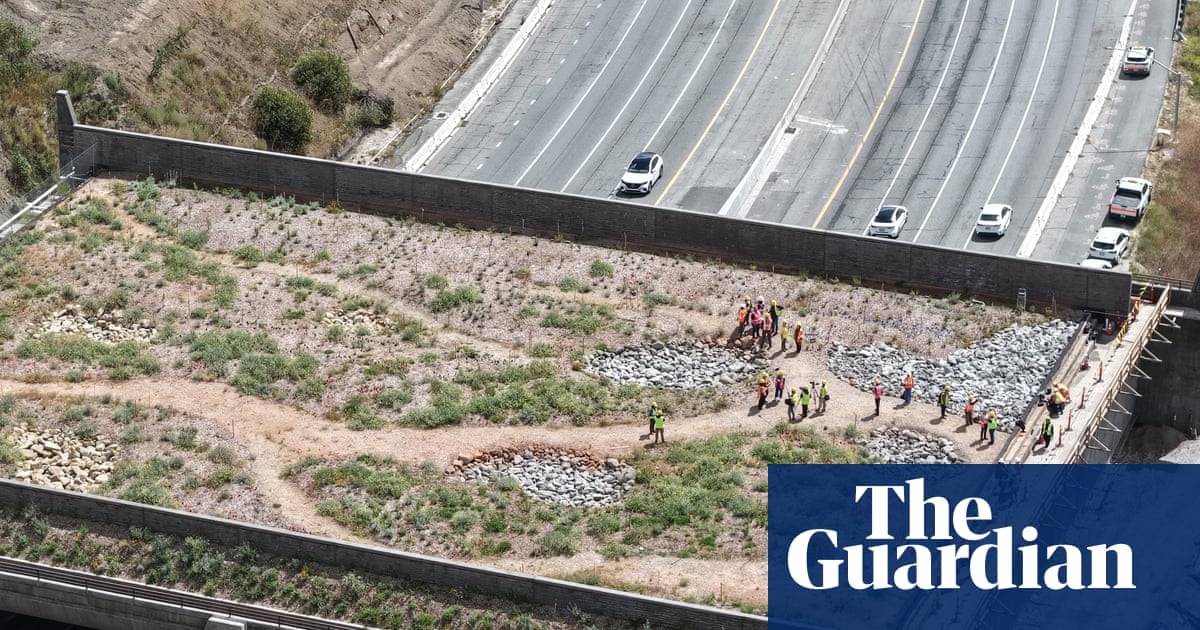
Building a large bridge like that, with the added complication of holding lots of protentially water soaked heavy soil and trees roots that try to break through the bottom isn’t cheap. More or less the same reason why roof-top parks are prohibitively expensive in most cases.
What I find a bit surprising is that they didn’t go for a tunnel for the cars, which is typically cheaper to do.
Easier to build a bridge over a freeway that already exists than to divert the freeway into a tunnel, I guess. Tunnels also require solid bedrock for structural integrity, which for all I know, this region may not have. And there may be additional risks in California with the frequency of earthquakes. But I’m not an expert, just assuming that they already weighed options and had reasons to settle on this approach.
Tunnels are even more unbelievably prohibitively expensive than this. Which makes sense, because typically one of the cheapest and most reliable ways to build a tunnel is actually pretty much the same thing they’re doing to build this bridge: cut and cover. You dig a trench where you want the tunnel to be with conventional excavation, put the road and tunnel in, then cover it back up with material over top. Here they just get to skip most of the initial excavation step, and go straight to “cover”.
Tunnels are a more costly than bridges, especially if you can’t just cut and cover.
That highly depends of the terrain and whats on top of it. Urban tunnels are much more expensive indeed.
Or just build a bridge for the cars. That’s probably the cheapest option.
But it wouldn’t look as good.
It wasn’t mentioned in the article, but I suspect there was also pressure to keep as much of the highway open for as long as possible. Putting in a tunnel, or changing the road to a bridge would close a major shipping route for months, whereas putting in an overpass can be done with staggered lane closures.
Or build a bridge next to the road while keeping the road open, and then close and demolish the road afterwards.
Yeah, but that’s just not going to work with the geography involved here, because there’s mountains to one side, and a stream to the other. The wildlife bridge is connecting two protected natural areas, which makes it perfect for wildlife, horrible for construction.
… are we talking about the same bridge? I don’t see mountains or a stream.
If you can’t see the mountains in the big picture at the top of that article, I can’t help you, but here’s an actual map of the area showing the stream:
https://www.openstreetmap.org/#map=18%2F34.138007%2F-118.728733
Something’s broke.
In the picture I see mountains miles away in the distance and I definitely don’t see a steam, you’re talking like the mountains and stream are right next to the bridge. At most there’s a hill next to the highway, and then on the other side looks like another road. No stream.
Maybe you can get the California Wildlife Crossing Database map to load, which shows the topography, although you have to zoom in to see the stream. https://arcg.is/1n001K3
Tunnels cost a fuck ton more.
When your comparing a roof load to a bridge load, the bridge live load is going to be significantly higher than an uninhabited roof. A typical bridge in the USA is designed for 640 psf plus a 72,000 lb truck. In contrast, a new roof isn’t designed for anything equivalent to that.
Hence me specifying roof-top parks. You know, with lots of waterlogged soil and trees. The static load of that is significantly higher, but of course heavy trucks cause lots of dynamic load, which is another difficult issue.